
This article was borrowed from Milesplit, but I felt that it was worth posting since Secaucus HS cross country teams travel to race on this course at least once every season. I try and make sure we run at here because of the tradition, history, and lore of this famous course. It is a fun course to race on!
Course of History: Van Cortlandt Park
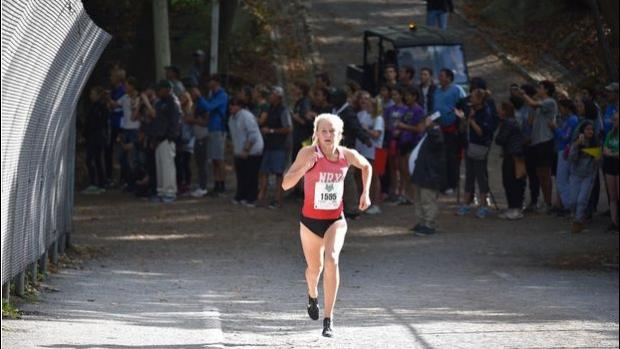
Photo by Harold Turk
About 17,000 years ago, enormous glaciers which covered much of North America began to recede, etching deep notches into the landscape in some places and depositing vast amounts of sediment in others. In the process, the 1,146 acres of the modern Bronx that would eventually become known as Van Cortlandt Park was given its distinctive topography: a vast field which erupts into ridges and undulating hillside.
Those very same features made it a logical choice for cross country racing, and in 1912 (or 1913 or 1914, depending on who you ask) the first competition was held on the now nationally celebrated course. And ever since, Van Cortlandt Park has been the home of cross country running not just for New York City, but much of the surrounding area. That said, the course athletes run on today looks quite a bit different from the one those earlier harriers skittered over.
The Parade Grounds – the flat, grassy expanse where most races begin and finish – are well-maintained today, with grass trimmed short and a modern drainage system installed that enables runners to maintain paces that would have been unthinkable to the first few decades of athletes to race at VCP.
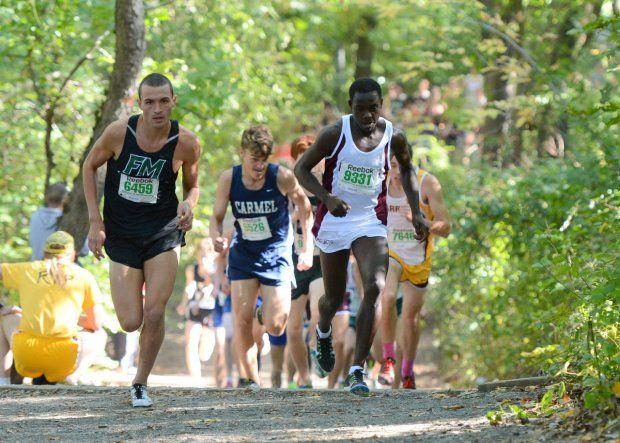
The Back Hills and Cemetery Hill (or Vault Hill, depending on your preferred name for the single steepest hill in the park) now feature packed gravel, smoothed by maintenance crews and protected from severe erosion by a series of strategically placed railroad ties. Those same trails used to be essentially single track, rocky, rooted, and if recently rained on, muddy and hellacious.
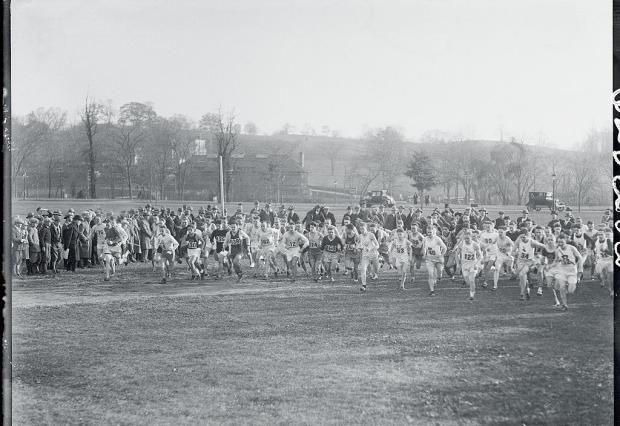
But the ebb and flow of the course has remained more or less the same the entire time: races start fast on the Parade Ground, or “the Flats,” an aptly nicknamed pancake flat field. For the 2.5 mile course, runners have about a quarter of a mile to sort themselves into position before funneling onto what’s known as the “Cow Path.” From there runners climb “Freshman Hill,” which includes a bridge over a highway, and leads to the section of the course with the quad-searing Back Hills. The roughly 2 kilometers that include this series of hills can be daunting, but athletes are rewarded over the final kilometer, which begins with a steep descent back toward the Flats then concludes with a sprintable stretch to the finish, generally lined with screaming fans.
Obviously these course features can be traversed a bit quicker now than back in the halcyon days of kangaroo skin spikes, busted ankles, and undetectable divots in the shoddily-maintained turf. But in addition to the runability of the course, the other major improvement to VCP over time has been the quality of competitor it attracts.
Since 1973, the Manhattan University Cross Country Invitational, more casually known as the Manhattan Invite, has drawn the best high school cross country runners and teams from the Mid-Atlantic and New England states. The most impressive results from this race tend to be the most impressive results ever run at Van Cortlandt Park, and to win the Manhattan Invite puts you in some illustrious company. The all-time lists for girls and boys are a who’s-who of cross country greats from within driving distance of New York City, and plenty of Olympians have honed their competitive chops here. (As of 2025, Katelyn Tuohy (13:21.8) and Edward Cheserek (11:55.4) hold the 2.5 mile course records.)
In 1979, New York City undertook its first significant improvements to the footing along the storied cross country course, to “eliminated the ruts, ravines and stones” that led to several high profile meets to seek out a new venue.
In 1997, the course was refurbished again, this time improving the footing even further. An enormous painted steel statue depicting a tortoise and a hare – along with thematically similar signs demarcating the course – was installed as part of this renovation work. And that’s because the standard high school course – typically and uniquely 2.5 miles in distance, although some races held at VCP are 5 kilometers long – remains honest.
Much like the fable of the brash hare and methodical tortoise, athletes tend to be awarded for their patience at Van Cortlandt Park, even with a faster surface. The Back Hills tax you and disrupt any rhythm you might develop along the Parade Ground. Go out too hard and you’ll barely make it home. Go out too conservatively and you’ll run out of real estate once you leave the hills to fully make up for lost time.
Though athletes do run fast at VCP, it’s not a place to run your fastest. It never has been. And that’s what’s so special about the place. In our speed and PR obsessive era, it’s refreshing for cross country racing to be about just that – racing – rather than throwing down the quickest result possible over either a 2.5 mile or 5 kilometer distance. Sure, posting a mark that lands you on the all-time VCP top-50 is an incredible career accolade, but ask any athlete on that list what they remember about the race that got them there, and they’ll tell you about how they fought through the Back Hills or how they dug deep to outkick a rival to the finish. That’s because VCP has always been, and will always be about pure racing.